01
About

The Architect of Clarity

A judicial mind shaped by decades of practice, elevated by constitutional vision, guided by the belief that law must serve humanity.

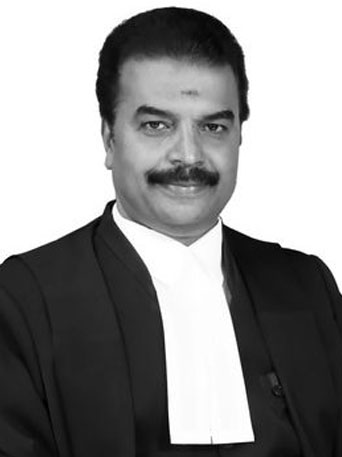
Justice R. Mahadevan
RM
Justice R. Mahadevan

A Life in Service of the Constitution

Justice R. Mahadevan is one of India's most distinguished jurists, currently serving as a Judge of the Supreme Court of India. His judicial career is defined by an unwavering commitment to constitutional principles, administrative justice, and the protection of fundamental rights.

Born and educated in Tamil Nadu, Justice Mahadevan pursued a legal career that would span decades before his elevation to the bench. As an advocate, he built a formidable reputation for constitutional interpretation and appeared in matters of significant public importance before the Madras High Court and Supreme Court of India.

In 2013, he was elevated as a Judge of the Madras High Court — one of India's oldest and most prestigious courts. Over the following decade, he delivered hundreds of judgments that have shaped state and national jurisprudence across domains including constitutional law, public interest litigation, taxation, and administrative law.

His tenure as Acting Chief Justice of the Madras High Court marked a period of significant institutional leadership, during which he guided the court through complex administrative and judicial challenges with characteristic clarity and resolve.

In 2024, Justice Mahadevan was elevated to the Supreme Court of India — the apex of the nation's judicial hierarchy — where he continues to shape Indian law at its highest level.

"The judiciary's greatest strength is its independence. Its greatest duty is to the people who cannot come before it."

— Justice R. Mahadevan

Principles of the Bench

The intellectual framework behind a consistent and principled judicial approach.

01

Constitutional Supremacy

Every interpretation must be anchored to the Constitution's foundational spirit — not merely its text, but its transformative intent for a democratic republic.

02

Judicial Restraint

The court's power is defined by its limits. Restraint is not timidity — it is the discipline that preserves the separation of powers and institutional integrity.

03

Access to Justice

The law must be accessible. Complex frameworks should not become barriers; every litigant deserves to understand the judicial process that governs their life.

04

Living Interpretation

The Constitution is a living instrument. Its words must be read through the lens of contemporary reality while preserving the wisdom of those who framed it.

05

Reasoning Transparency

A judgment must expose its reasoning completely. The public has a right to understand not just what was decided, but why — every step, every premise.

06

Protection of Rights

The fundamental rights of citizens are not political gifts but constitutional guarantees. Their protection is the most sacred duty of the judicial branch.

The Architecture of a Career

1990s
Legal Education & Early Career
Madras Bar
Completed legal education and joined the Bar. Began practice at the Madras High Court, rapidly developing expertise in constitutional and administrative law.
2000s
Senior Advocate
Madras High Court
Designated as Senior Advocate, having established a distinguished practice. Handled significant matters in constitutional law, taxation, and public interest litigation.
2013
Elevated to the Bench
Judge, Madras High Court
Appointed as a Judge of the Madras High Court — one of India's oldest High Courts, established in 1862. Began delivering judgments across constitutional, civil, and criminal matters.
2023
Acting Chief Justice
Madras High Court, Chennai
Served as Acting Chief Justice of the Madras High Court, overseeing the administrative and judicial functions of one of India's most significant High Courts during a critical period.
2024
Supreme Court of India
Judge, Apex Court
Elevated to the Supreme Court of India — the apex court and the final arbiter of the Constitution. Continues to shape Indian jurisprudence at the highest level of the judicial hierarchy.