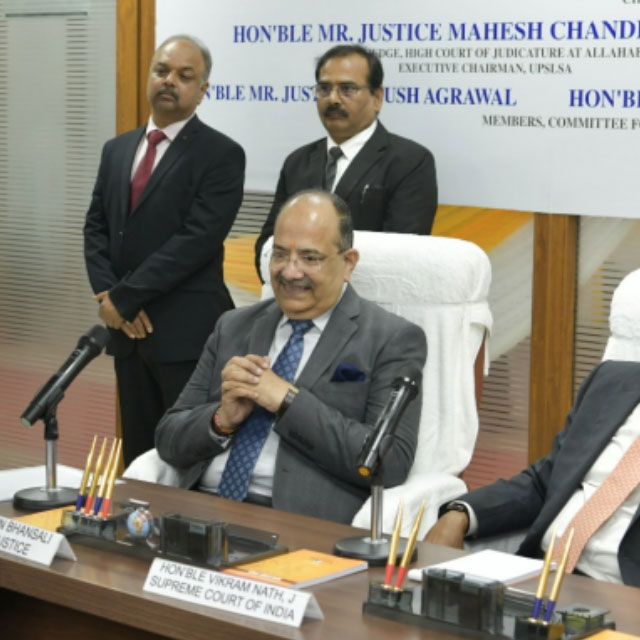
System Profile
About Justice Vikram Nath
A distinguished jurist whose career spans three decades of constitutional service, progressive thinking, and pioneering judicial innovation.
A distinguished jurist whose career spans three decades of constitutional service, progressive thinking, and pioneering judicial innovation.
Justice Vikram Nath was born into a family with deep legal roots in Uttar Pradesh. His father, a respected legal practitioner, instilled in him the values of integrity, fairness, and dedication to the rule of law from an early age. These foundational principles would go on to shape one of the most distinguished judicial careers in modern Indian jurisprudence.
After completing his legal education, Justice Nath enrolled as an advocate with the Bar Council of Uttar Pradesh in 1987. He practiced extensively in constitutional, civil, and revenue matters at the Allahabad High Court, building a reputation for meticulous legal analysis and profound understanding of constitutional principles.
His elevation to the bench of the Allahabad High Court in 2004 marked the beginning of a judicial career that would see him serve with distinction across multiple courts, ultimately reaching the highest court of the land — the Supreme Court of India.
CURRENT ROLE
PREVIOUS ROLE
ENROLLED AS ADVOCATE
ELEVATED TO HC BENCH
First to implement live broadcasting of High Court proceedings during COVID-19, setting a national precedent.
Justice Vikram Nath's judicial philosophy is rooted in the belief that justice must not only be done, but must be visibly seen to be done. Throughout his career, he has championed the principle that an open and accessible judiciary is fundamental to a thriving democracy.
His approach to adjudication reflects a deep commitment to constitutional values — the rule of law, equality before law, and the protection of fundamental rights. He believes that the power of the judiciary lies not in its authority alone, but in the trust that citizens place in its processes and outcomes.
The landmark decision to livestream court proceedings was not merely administrative — it was philosophical. It embodied the conviction that transparency strengthens institutions, that openness builds public confidence, and that technology, when wielded with purpose, can advance the cause of justice rather than diminish it.
A chronological record of key milestones in a career spanning three decades of judicial service.
Elevated to the Supreme Court, bringing a wealth of experience in constitutional law and a proven track record of judicial innovation. Continues to shape jurisprudence on matters of constitutional significance.
Served as Chief Justice with distinction. Pioneered the livestreaming of court proceedings during the COVID-19 pandemic, making justice accessible to millions and setting a transformative precedent for the Indian judiciary.
Served on the bench of the Allahabad High Court for over 16 years, adjudicating a wide spectrum of constitutional, civil, criminal, and revenue matters. Known for well-reasoned judgments and adherence to constitutional principles.
Enrolled as an advocate with the Bar Council of Uttar Pradesh. Practiced before the Allahabad High Court, specializing in constitutional, civil, and revenue law. Developed expertise through extensive litigation across diverse legal domains.
Began his legal career by enrolling with the Bar Council, marking the start of a journey that would lead to the highest court in India.
Led the implementation of live broadcast of court proceedings during the pandemic, ensuring continuity of justice and establishing a new model for judicial transparency.
Championed the adoption of technology in court administration, including e-filing, virtual hearings, and digital case management systems.
Advocated for measures to make the justice system more accessible to ordinary citizens, reducing barriers of distance, language, and complexity.