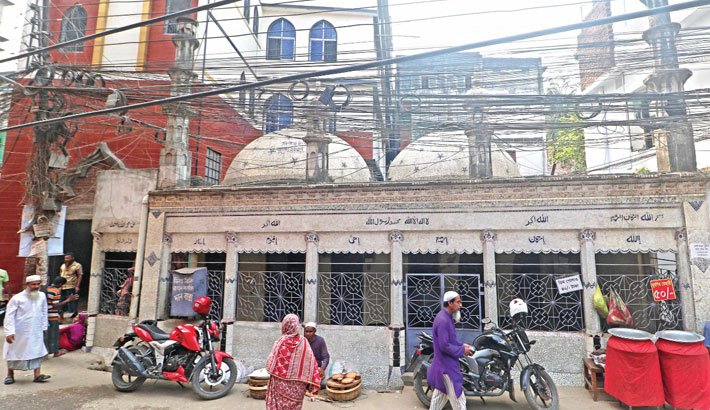
Long before the Mughals would set foot in Bengal, in the closing years of the reign of Sultan Nasiruddin Mahmud Shah, a woman named Bakht Binat — daughter of Marhamat — endowed a small mosque in the village of Narinda. The Arabic foundation inscription that survives above its entrance dates the work to 861 AH (1457 CE), making this the earliest dated surviving mosque of what is today the city of Dhaka.
The masjid takes its enduring name — Binat Bibi, “the lady, daughter of” — from this remarkable patroness, whose act of piety entered Bengal’s long architectural memory and never left it.
Bakht Binat endows the masjid in the village of Narinda during the reign of Sultan Nasiruddin Mahmud Shah. The Arabic inscription above the entrance records the date.
As Dhaka grows from a riverside settlement into a regional centre, the masjid quietly continues its daily life of prayer, witnessing the transformation of Narinda from village to city neighbourhood.
Subahdar Islam Khan moves the provincial capital to Dhaka. The masjid — already over 150 years old — is by now one of the oldest landmarks in the new imperial city.
Through political upheaval, demographic change and reconstruction, the community keeps the masjid alive. Documentation by colonial-era surveyors begins to record its architectural significance.
Recognised by historians as among the earliest surviving sultanate-period mosques in eastern Bengal, the blue minaret of Binat Bibi Masjid becomes one of the most photographed elements of Old Dhaka’s skyline.
The masjid serves a daily congregation while a heritage trust supports careful conservation, scholarship and respectful cultural exchange — opening its story to a global audience.
Its surviving 1457 CE inscription makes it the oldest precisely-dated standing mosque in Bangladesh’s capital city — a benchmark for the regional history of Islamic architecture.
In an era when public religious patronage is too often remembered through male names, the masjid stands as a quiet, enduring testament to a 15th-century woman’s vision.
Surviving sultanate, Mughal, colonial and modern periods, it is a rare unbroken thread linking pre-imperial Bengal’s Islamic civilisation to the city’s present-day spiritual life.