Chapter I
The Daksha Yajna — Pride That Shattered the Universe
In the beginning was a sacrifice — not of the gods, but for them. Daksha Prajapati, father of Sati, summoned every deity, sage and celestial to a great yajna on the slopes of the Himalayas. To one alone was no invitation extended: Lord Shiva, the husband of his daughter.
The ancient texts — the Devi Bhagavata Purana, the Kalika Purana, the Linga Purana — recall the moment with reverence. Daksha had set himself against the ascetic ways of his son-in-law. The yajna was to be a public assertion of his patriarchal authority and a public humiliation of the Mahadev. Sati, daughter of Daksha and consort of Shiva, was made to choose between the will of her father and the dignity of her husband.
She chose, and history bent before her choice.
Chapter II
Sati's Sacrifice — The Self-Offering of the Devi
Sati arrived at the yajna unannounced, refused, and finally insulted. To stand silent while Shiva was scorned was, for her, an unthinkable transgression of dharma. Standing at the altar, before the assembled gods and her own father, she invoked the inner fire of her yogic discipline and immolated herself in the sacrificial flame.
It was not death but transmutation — the Devi withdrawing her presence from a world that had betrayed her dignity, leaving behind only her body, sanctified beyond ordinary fire.
From this moment, the cosmos itself trembled. The yajna fire became inauspicious. The gods fled. And from his Himalayan abode, the silence of Mahadev began to break.
Chapter III
Shiva's Grief — The Tandava that Tore the Sky
Shiva descended upon Daksha's yajna in fury. He severed Daksha's head, scattered the gods, and lifted the body of Sati upon his shoulders. The mythological texts speak of an unbearable lamentation — the Mahadev, the absolute ascetic, transformed into the inconsolable mourner.
Carrying her body across the cosmos, Shiva began the Rudra Tandava — a dance of grief so terrible that the universe itself began to dissolve. The boundaries between worlds shook; the dharma that holds creation in balance threatened to unravel.
To preserve the world, Lord Vishnu followed silently behind. With his Sudarshana Chakra, he severed the body of Sati limb by limb, fragment by fragment, until at last Shiva's grief found a place to rest.
Chapter IV
The Falling of the Right Arm — The Birth of a Shaktipeeth
The body of Sati did not vanish. Where each part fell upon the earth, the ground was sanctified — and there a Shaktipeeth arose. The traditions count fifty-one such places — from Hinglaj in the west to Kamakhya in the east, from Nainadevi in the north to Kanyakumari in the south, weaving the Devi's body into the sacred geography of the Indian subcontinent.
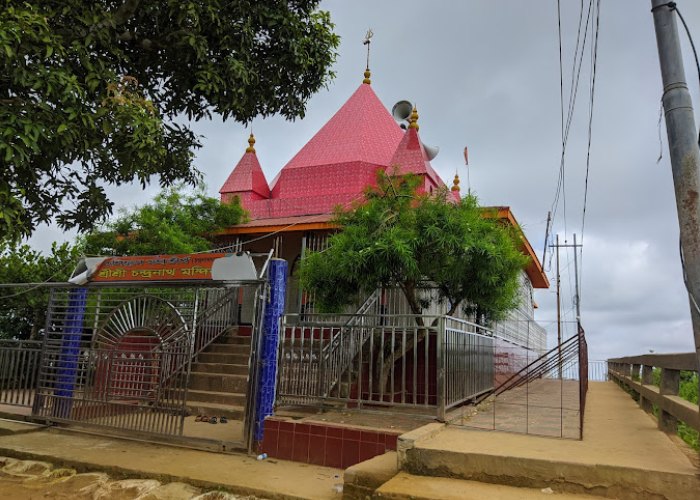
And here, on the highest hill of Sitakunda, the right arm of the Goddess descended.
This is Chandranath. This is its origin. The earth that received the right arm of Sati became, from that instant, an axis of Shakti — a place where the Devi is not symbolised but is present.
Chapter V
The Manifestation of Bhavani
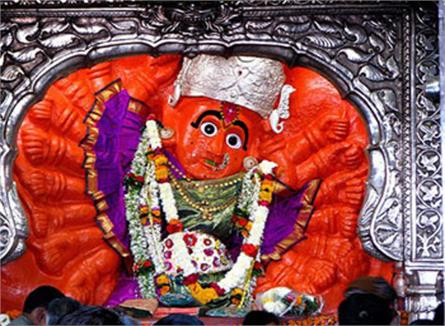
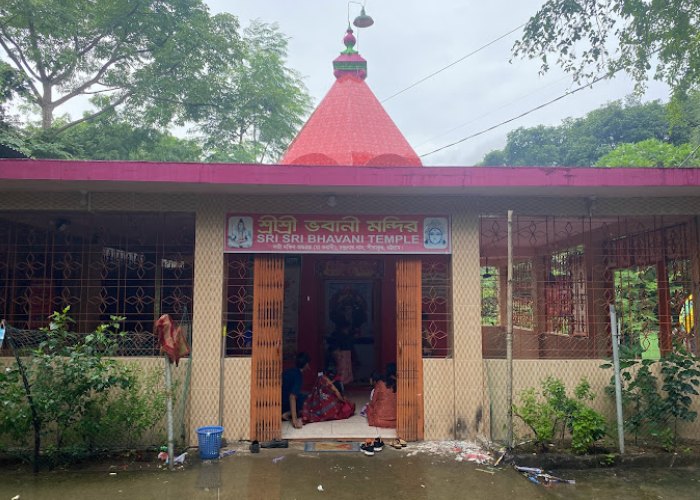
Where the right arm fell, the Devi did not remain a relic. From that very ground, she manifested as Bhavani — the giver of life, the protector of devotees, the radiant Mother of all that breathes. The name carries the meaning of the source itself: Bhava — existence — and Bhavani — she from whom existence flows.
Worship at Chandranath, then, is not the worship of an absent goddess but the recognition of an immediate one. The hill is not a memorial — it is a residence.
Chapter VI
Chandrashekhar — The Bhairav of the Hill
Every Shaktipeeth has its presiding Bhairav — the form of Shiva who guards the place where the Devi dwells. At Chandranath, this Bhairav is Chandrashekhar — Shiva who carries the moon upon his crown.
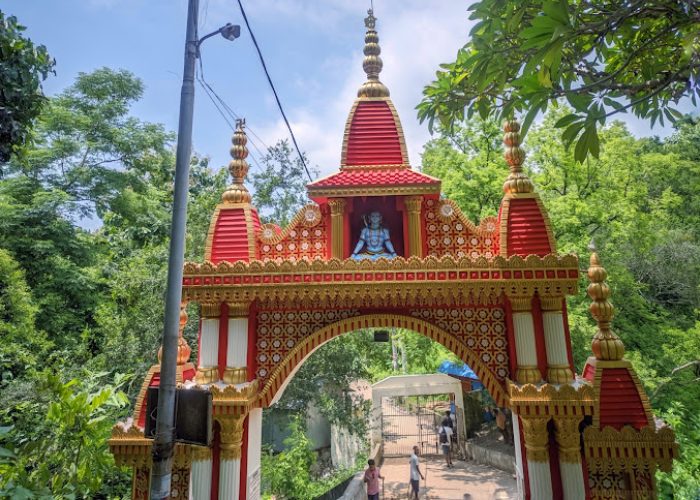
The hill itself is named for him: Chandranath, "the Lord of the Moon." It is said that at the summit, the Mahadev took up his ascetic seat to remain forever near his consort, the moon over his head reflecting the cool, eternal light of his vigil.
Thus the temple is not a single deity's shrine but a meeting — the Devi below as Bhavani, the Mahadev above as Chandrashekhar — and the pilgrimage is the journey between them.
Chapter VII
Historical References & Inscriptional Echoes
Beyond mythology, Chandranath enters the historical record through the layered geography of medieval Bengal. The hill is referenced in the Tantrachudamani — one of the foundational tantric texts that enumerate the Shaktipeethas — and in the Pithanirnaya, where it is identified by the name Bhavani and the Bhairav Chandrashekhar.
European travellers passing through Chattogram in the seventeenth and eighteenth centuries described the temple-cluster of Sitakunda as one of the most active pilgrim sites of eastern Bengal. Local chronicles record the patronage of regional rulers, the construction of subsidiary shrines, and the periodic restoration of the summit temple after storms and seismic events.
Chapter VIII
A Temple Legacy Across Centuries
Empires rose and dissolved around Chandranath — Pala, Sena, Sultanate, Mughal, colonial, post-colonial. The temple endured. Devotees climbed in war and peace, in plenty and in famine. The Shiv Chaturdashi Mela has been held, in some form or another, for centuries — a continuity rare in the religious geography of South Asia.
Today, the temple stands at the heart of a renewed initiative — to safeguard its sanctity, to dignify the pilgrim experience, and to share its civilisational meaning with the wider world while keeping its sacred core inviolate.
This is the work of the present trust, the leadership and the heritage partners now custodians of Chandranath: to receive what was passed down, and to pass it on intact.